Architecture: Mazdaspeed 3 MZR DISI 2.3 L Turbo
What Is the Best Turbo Upgrade for the Mazdaspeed 3 / 6 MZR DISI 2.3L?
The best turbo upgrade for the Mazdaspeed 3 and Mazdaspeed 6 MZR DISI 2.3L depends on your power target. For 350–400 WHP on a stock-block engine, the Kinugawa TD05H-18G is the direct bolt-on replacement for the OEM K04, offering a 12% larger compressor inducer, a larger turbine exducer to reduce exhaust backpressure, and a 360-degree thrust bearing that eliminates the K04’s most common failure mode. For 450–500 WHP with a built engine, the TD05H-20G with 3" anti-surge housing extends the compressor map while preventing surge at high boost. For 550+ WHP track builds, the TF06-18K ball bearing with 4" inlet and point-milled billet 7+7 compressor wheel is the top-tier option.
1. Why the OEM K04 Fails at High Power Levels
The factory turbocharger on the Mazdaspeed 3 is a K04 variant (K0422-881 or K0422-882), manufactured by Hitachi under BorgWarner license. At stock output (~263 BHP) it is adequate, but it becomes the primary restriction for any build targeting 300+ WHP.
1.1 Geometric Limitations and Volumetric Efficiency
The OEM K04 uses a cast aluminum compressor wheel with a 45.0mm inducer and 56.25mm exducer. The turbine wheel is a standard 12-blade cast Inconel design with a 50.1mm inducer and 44.5mm exducer. These dimensions define the turbocharger’s choke line — the point at which the compressor can no longer supply the required air mass without generating excessive heat or reaching sonic blade-tip speeds.
For a 2.3L four-cylinder, these wheel sizes act as a restrictor plate above 5,500 RPM. The small turbine wheel and tight turbine housing Area/Radius (A/R) ratio create excessive Exhaust Manifold Absolute Pressure (EMAP). This backpressure traps hot exhaust gases in the combustion chamber during valve overlap, dilutes the incoming air-fuel charge, raises cylinder temperatures, and forces the ECU to pull ignition timing — producing the characteristic power drop-off Mazdaspeed owners experience near the redline.

Which Turbine Housing A/R Works Best?
1.2 Mechanical Failure: The Thrust Bearing Problem
The OEM K04 uses a 270-degree thrust bearing pad. When boost pressure is increased beyond stock levels (21+ PSI), axial loads increase exponentially. The 270-degree pad leaves a quadrant of the thrust collar unsupported, causing uneven load distribution during transient boost events. Over time, the oil film breaks down, metal-on-metal contact occurs, shaft play develops, and the turbine-side oil seal fails — producing the blue/white smoke at idle that signals a dying K04.

Rebuilding or replacing the K04 with another OEM unit reintroduces the same structural weakness. The Kinugawa solution replaces the K04 architecture entirely with the more robust Mitsubishi-derived TD05H and TD06/TF06 frames.
2. The Kinugawa Frame Evolution: TD05H, TD06SL2, and TF06
Kinugawa adapts TD05H and TD06/TF06 bearing housings and wheel profiles — architectures proven in the Mitsubishi Lancer Evolution and Subaru WRX STI markets — to fit the Mazda footprint. This bolt-on approach retains compatibility with the stock exhaust manifold and downpipe flanges while fundamentally improving the engine’s breathing characteristics.
2.1 Street Performance Standard: TD05H-18G (350–400 WHP)
For Mazdaspeed owners targeting 300–400 WHP, the TD05H-18G is the optimal balance of transient response and mass flow capacity.

Kinugawa Turbo TD05H-18G for MAZDA Mazdaspeed 3 6 MPS MZR DISI 2.3L CX7 CX9
Price: $989.00 USD
Direct bolt-on K04 replacement. 400 WHP capable with excellent throttle response. Fits 2007–2013 Mazdaspeed 3/6, CX-7, CX-9.
Buy Now — $989.002.1.1 Compressor Aerodynamics: The 18G Profile
The 18G compressor wheel features a 50.3mm inducer and 68.0mm exducer — a 12% larger inducer area and 21% larger exducer diameter than the OEM K04 (45mm / 56.25mm). Billet construction allows thinner blade profiles and smaller hub diameters than cast wheels, maximizing effective flow area and reducing rotational inertia for faster spool despite the larger physical size.

Why is the splitter blade (6+6) better for low-end torque?
2.1.2 Turbine Dynamics: The TD05H Advantage
The TD05H turbine wheel measures 56.0mm inducer / 49.2mm exducer. The larger exducer (49.2mm vs. OEM 44.5mm) increases the flow area at the turbine exit, reducing EMAP and improving cylinder scavenging at high RPM. The result is a power curve that pulls hard to the redline rather than falling off above 5,500 RPM.
2.2 Mid-Range Power: TD05H-20G with 3" Anti-Surge (450–500 WHP)
For builds targeting 450–500+ WHP with forged internals, the TD05H-20G steps up to a 52.3mm inducer / 68.0mm exducer, supporting higher pressure ratios (25–30 PSI) without superheating the intake charge. The 3" ported shroud (anti-surge) compressor cover prevents surge at low RPM by recirculating excess air back into the intake stream, protecting the bearing assembly from axial shock loads.

Kinugawa Turbo 3" TD05H-20G for MAZDA Mazdaspeed 3 6 MPS MZR DISI 2.3L CX7 CX9
Price: $899.00 USD
3" anti-surge inlet. Strong mid-to-high-range response. Fits 2007–2013 Mazdaspeed 3/6, CX-7, CX-9.
Buy Now — $899.00
How does the anti-surge compressor housing work?
2.3 Track Dominator: TF06-18K Ball Bearing 4" (550+ WHP)
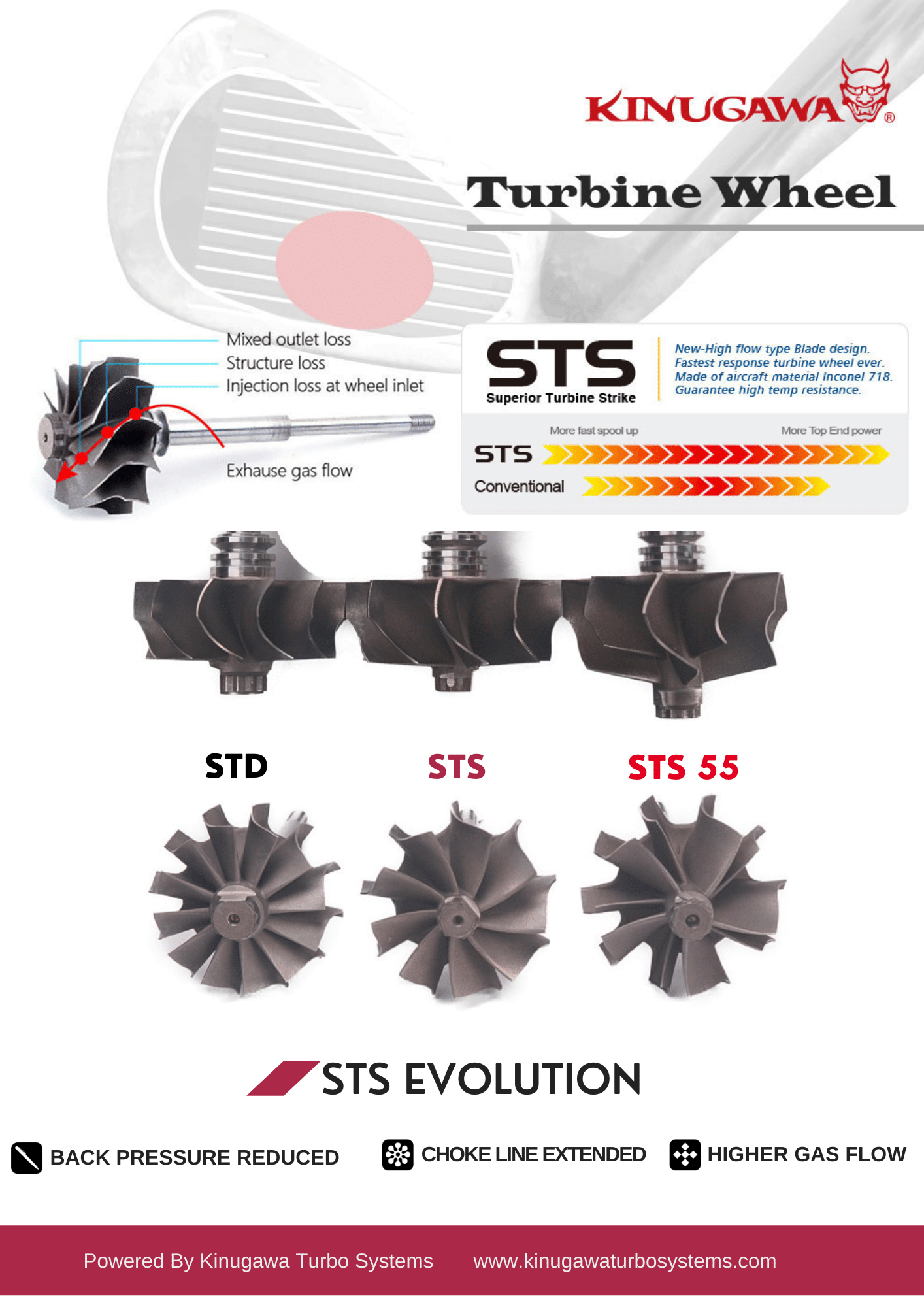
The TF06-18K uses Kinugawa’s proprietary STS (Superior Turbine Strike) 9-blade turbine geometry. Removing 2–3 blades from the turbine wheel reduces total rotating mass, lowers backpressure by increasing the exhaust throat’s swallowing capacity, and allows a larger turbine wheel to spool with the responsiveness of a smaller one. Kinugawa data indicates a 5–8% reduction in time-to-boost versus a standard 12-blade wheel of the same diameter.

Kinugawa Turbo Ball Bearing 4" TF06-18K for MAZDA Mazdaspeed 3 6 MPS MZR DISI 2.3L CX7 CX9
Price: $1,539.00 USD
450+ WHP. 4" inlet, dual ceramic ball bearing, billet 7+7 point-milled compressor wheel. Fits 2007–2013 Mazdaspeed 3/6, CX-7, CX-9.
Buy Now — $1,539.002.3.1 STS 9-Blade and 5+5 10-Blade Turbine Geometry
- Mass Reduction: Removing 2–3 blades reduces turbine wheel mass, lowering rotational inertia and yielding a 5–8% reduction in time-to-boost versus a standard 12-blade wheel of the same diameter.
- Flow Area Expansion: Fewer blades reduce physical blockage in the exhaust throat, increasing swallowing capacity, lowering EMAP, and reducing Exhaust Gas Temperatures (EGT).
- Efficiency Optimization: Optimized blade curvature maintains high efficiency across the operational range, allowing a larger turbine wheel to spool with the responsiveness of a smaller one.
3. Bearing Systems: Journal vs. Ball Bearing
The reliability of a turbocharger is defined by its bearing system. Kinugawa addresses the K04’s thrust bearing weakness with two distinct solutions.
3.1 360-Degree Performance Journal Bearing
Kinugawa journal bearing units use a 360-degree thrust bearing kit. Unlike the OEM 270-degree pad, the 360-degree washer provides full-circle axial load support, doubling the load-carrying capacity and making it virtually immune to the thrust failures that plague the stock K04 at high boost. This is the cost-effective, reliable choice for daily drivers.

Oil Pads Ramping: The Secret to Boosting Performance and Turbo Life
3.2 STS Advanced: Dual Ceramic Ball Bearing
The STS Advanced system uses a dual ceramic ball bearing cartridge. Rolling element bearings generate significantly less friction than hydrodynamic journal bearings, particularly during spool-up. Key advantages:
- Friction Reduction: Lower drag coefficient allows the turbine to accelerate more rapidly from low RPM.
- Transient Response: Boost response speed improves by 10–15%, most noticeable during gear shifts and corner exits.
- Material Science: Ceramic balls reduce rolling element mass, lower heat generation, and provide precise shaft control against gyroscopic forces.

Ball Bearing vs. Journal Bearing Turbos
4. System Integration: What Else Do You Need?
A Kinugawa turbo is bolt-on in terms of flange compatibility, but it is a system upgrade that requires supporting modifications. Installing a high-flow turbo without addressing these components will result in suboptimal performance or engine failure.
4.1 Fueling: HPFP Internals (Mandatory)
The stock High Pressure Fuel Pump (HPFP) cannot maintain rail pressure as airflow increases past stock levels. Installing a Kinugawa 18G without upgraded HPFP internals (Autotech or CorkSport) will cause fuel pressure drop, a lean mixture under boost, detonation, and engine destruction. This is a mandatory prerequisite for any turbo upgrade on this platform.
4.2 Engine Management and Tuning (Mandatory)
The stock ECU is calibrated for the K04. A custom tune via Cobb Accessport or Versatuner is required to rescale MAF sensor calibrations, adjust load targets, and optimize ignition timing for the new turbo’s efficiency islands.
4.3 Intercooling
The stock Top Mount Intercooler (TMIC) heat-soaks even with the stock turbo. With a Kinugawa unit, upgrading to a Front Mount Intercooler (FMIC) or a larger Top Mount (3.5" core) is strongly recommended to maintain consistent power and prevent knock.
4.4 Exhaust / Downpipe
A 3-inch high-flow or catless downpipe is essential to minimize post-turbine backpressure and allow the STS turbine wheel to extract maximum energy from the exhaust gas.
4.5 Oil and Water Management

- Journal Bearing Units: Use a -4AN feed line (~0.25" inner diameter). No restrictor required unless engine oil pressure is excessive.
- Ball Bearing Units: A 1.0–1.5mm oil restrictor orifice is mandatory. Excessive oil pressure floods the bearing cartridge, causes ball skidding, and forces oil past the dynamic seals.

Does my turbo require an oil restrictor?
4.6 Oil Drain Orientation
The oil drain line must be vertical within +/−15 degrees. Any kinks, restrictions, or uphill sections will cause oil to back up into the CHRA, flooding the housing and leaking into the exhaust or intake — producing the “smoking turbo” symptom that is often misdiagnosed as a failed seal.

When installing your turbocharger, ensure the axis of rotation is parallel to level ground within +/−15°. The oil inlet/outlet must be within 15° of perpendicular to level ground.
4.7 Actuator Setup and Boost Control
The Kinugawa adjustable billet actuator ships with a default 1.0 bar / 14.7 PSI spring. Set the actuator rod with 2mm of preload to hold the wastegate valve tightly shut against the turbine housing seat and prevent exhaust leaks that delay spool-up. Preload is adjusted by turning the rod nut two full turns (~2mm). Custom base boost pressure is achievable by swapping springs within the actuator canister.

How to replace the actuator spring and hold the boost pressure as the table described?
5. Turbocharger Specification Comparison
| Feature | OEM K04-882 | Kinugawa TD05H-18G Bolt-On | Kinugawa 3" TD05H-20G | Kinugawa 4" TF06-18K |
|---|---|---|---|---|
| Comp. Inducer | 45.0 mm | 50.3 mm | 52.3 mm | 55.1 mm |
| Comp. Exducer | 56.25 mm | 68.0 mm | 68.0 mm | 75.0 mm |
| Turbine Inducer | 50.1 mm | 56.0 mm | 56.0 mm | 61.5 mm |
| Turbine Exducer | 44.5 mm | 49.2 mm | 49.2 mm | 54.0 mm |
| Blade Tech | Cast 12-Blade | Billet 6+6 / 11+0 | Billet 6+6 / 11+0 | Billet 7+7 (Point-Milled) |
| Turbine Tech | Standard | STS 9-Blade | STS 9-Blade | 9-Blade |
| Bearing | Journal (270°) | Journal (360°) / Ball | Journal / Ball | Journal / Ball |
| Max HP Rating | ~260–280 WHP | 350–400 WHP | 450–500 WHP | ~600 WHP |
The TD05H-18G is the direct functional superior to the OEM K04, sharing similar wheel dimensions to competing aftermarket options but differentiating with STS turbine technology across the range and the option for a dual ceramic ball bearing center section — a feature typically reserved for significantly more expensive turbochargers.
6. Conclusion: Which Kinugawa Turbo Is Right for Your Mazdaspeed Build?
The transition from the stock K04 to a Kinugawa TD05H or TF06 series turbocharger is a fundamental re-engineering of the Mazdaspeed 3’s induction system. By addressing the root causes of the OEM unit’s limitations — exhaust backpressure and the weak thrust bearing architecture — Kinugawa unlocks the latent potential of the MZR DISI engine.
- 350–400 WHP street build: TD05H-18G Bolt-On
- 450–500 WHP built engine: 3" TD05H-20G Anti-Surge
- 550+ WHP track weapon: 4" TF06-18K Ball Bearing
Appendix A: Glossary of Technical Terms
- CHRA (Center Housing Rotating Assembly): The core of the turbocharger containing the turbine shaft, compressor wheel, and bearing system.
- A/R (Area/Radius): A ratio defining turbine housing geometry. Larger A/R = more top-end flow, slower spool. Smaller A/R = faster spool, more backpressure.
- STS (Superior Turbine Strike): Kinugawa’s proprietary 9-blade turbine wheel design, engineered to reduce mass and backpressure for faster spool.
- Billet Compressor Wheel: Machined from a solid block of forged aluminum (Milled from Solid — MFS), offering higher strength-to-weight ratio and thinner blade profiles than cast wheels.
- EMAP (Exhaust Manifold Absolute Pressure): Pressure in the exhaust manifold before the turbine. Lower EMAP is critical for volumetric efficiency and knock prevention.
- Point Milling: Advanced machining process for billet wheels enabling complex 3rd-order surface blade curvatures for improved aerodynamic efficiency.
Appendix B: Recommended Supporting Modifications
- HPFP Internals: Autotech or CorkSport — essential for all turbo upgrades
- Engine Management: Cobb Accessport or Versatuner for ECU calibration
- Downpipe: 3-inch diameter, catless or high-flow catalytic converter
- Intercooler: FMIC or upgraded Top Mount (3.5" core)
- Intake: 3-inch or larger intake system to match the turbo inlet
- Boost Control: 3-Port Electronic Boost Control Solenoid (EBCS)