

Kinugawa TD series turbocharger part numbers encode the turbine wheel frame size, compressor wheel type, turbine housing area, and optional suffixes for wheel width and rotation direction. This guide decodes every element of the naming convention so you can identify the right turbo for your application.
What Does the Kinugawa TD Series Code Mean?
The TD prefix stands for Turbine Driven. The number following (e.g. 04, 05, 06) designates the turbine wheel frame size class. Additional letters and numbers specify the compressor wheel, turbine housing, and configuration.

| Turbocharger | T = Exhaust Gas Turbocharger D = Turbo design series (not alphabetical) 04 = Turbine wheel frame size H = Optional suffix for enlarged diameter |
| Compressor | 08 = Compressor size: at highest efficiency on compression line ratio π = 2, air flow is 0.08 m³/sec T = Compressor wheel design type (not alphabetical) |
| Turbine | H = Optional suffix for wheel width: S = small, M = medium, L = large R = Optional suffix for reverse rotation 6.5 = Turbine housing throat area = 6.5 cm² (dimension A in A/R), or VG for Variable Geometry, or total area + T/S suffix for Twin Scroll |
| Hybrid Turbocharger | When using a compressor wheel from another turbine series, it is called a hybrid. Example: TD04-04H*13T-6.5 T/S — a 13T compressor from the TD04H series combined with a TD04 turbine. |
1. Turbine Housing Sizes: cm² to A/R Conversion
Kinugawa turbine housings are rated in cm² throat area. The table below converts these to the A/R ratios commonly used with Garrett turbochargers.
| Throat Area (cm²) | Equivalent A/R |
|---|---|
| 6 cm² | 0.41 A/R |
| 7 cm² | 0.49 A/R |
| 8 cm² | 0.57 A/R |
| 9 cm² | 0.65 A/R |
| 10 cm² | 0.73 A/R |
| 11 cm² | 0.81 A/R |
| 12 cm² | 0.89 A/R |
TD04-based turbochargers use 5–7 cm² turbine housings. TD05 series turbochargers typically use 6–10 cm² housings.
2. Compressor Wheel Types: G, T, GK, TK, KX Series
Kinugawa compressor wheels are identified by a number (specific wheel) joined with a letter (blade arrangement or trim). The main series are:
- G series: Alternating blade heights and fin curvature — standard performance design.
- KX series: Latest generation, CNC point-milled with 3rd-order free surface geometry for maximum efficiency.
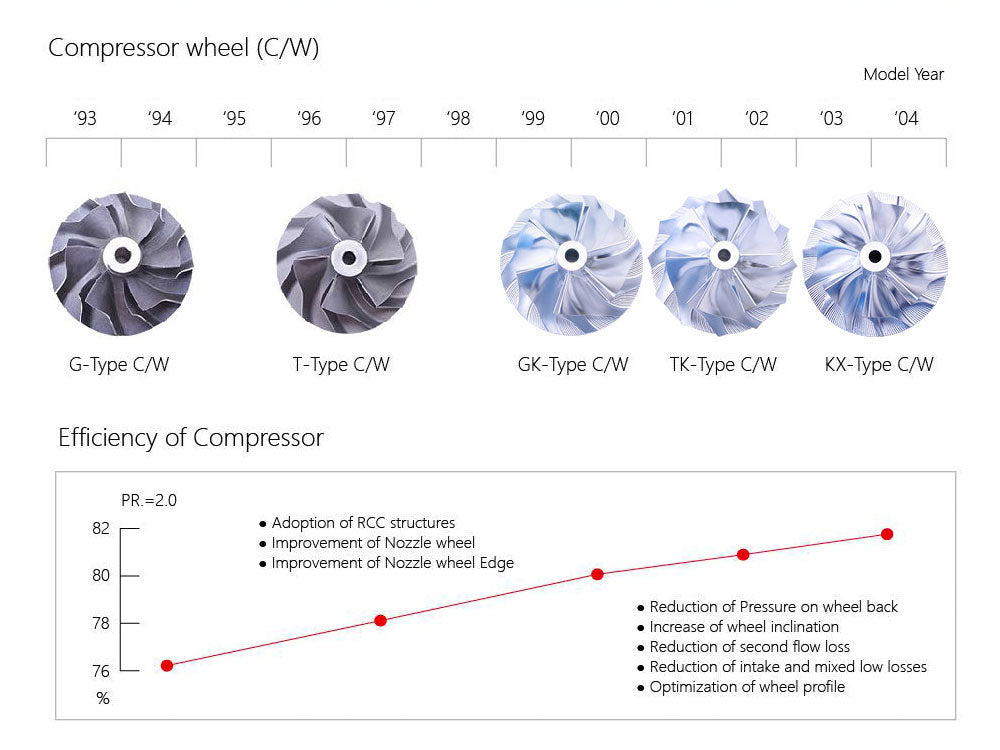

Free Surface (Point Milling) vs Ruled Surface (Flank Milling)
| Free Surface (KX / Point Milling) | Ruled Surface (Flank Milling) | |
|---|---|---|
| Process | Point Milling | Flank Milling |
| Machining Time | Slow — 120 min/each | Quick — 15 min/each |
| Characteristics | 3D free surface design; higher pressure ratio; broader flow range; peak compressor efficiency up to 81.8%. Mainly for high-efficiency turbochargers. | Ruled surface only; lower efficiency; suitable for basic centrifugal compressor designs. |
3. Turbine Wheels: TD04 vs TD05 Compatibility
Any TD04 series compressor wheel fits any TD04 series shaft — whether TD04H, TD04HL, or TE04H. TD04 and TD05 compressor wheels are not interchangeable due to the difference in shaft hole diameter. Sleeving a TD05 wheel onto a TD04 shaft is possible but requires precise balancing; an oversized wheel risks shaft failure or uneven bearing wear at high speeds.
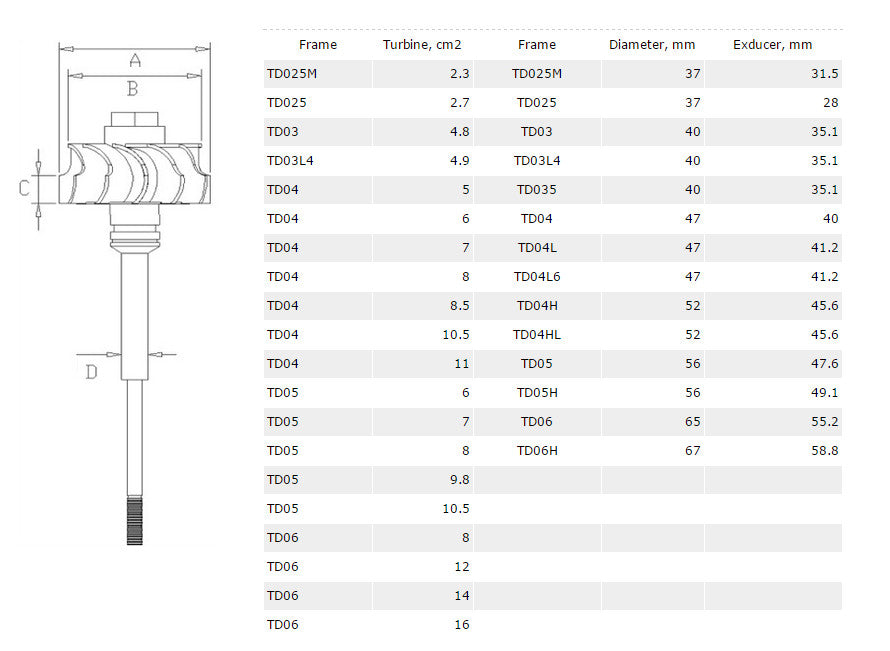
3.1 Turbine Wheel Frame Characteristics
3.2 What Is STS (Superior Turbine Strike) Technology?
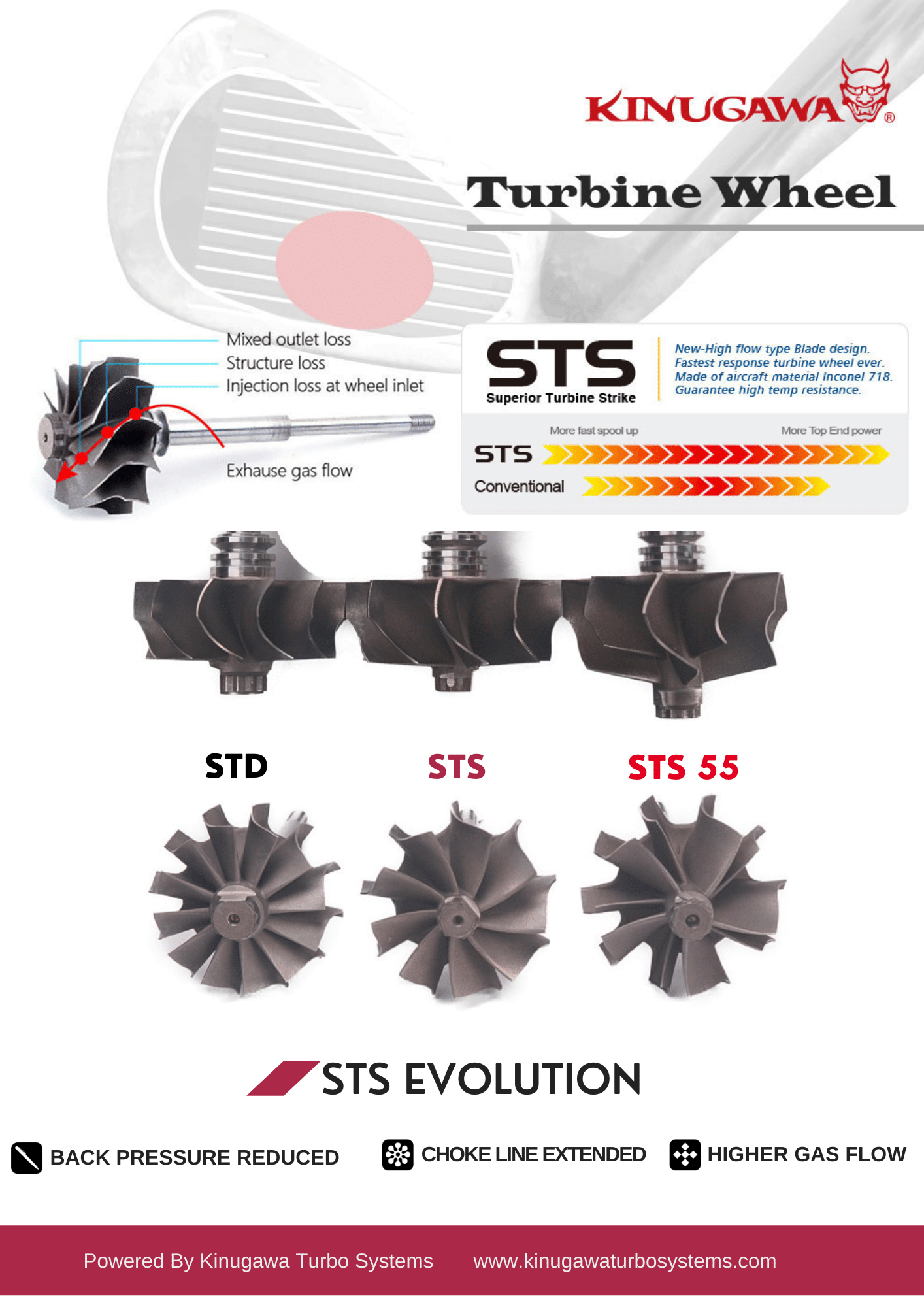
The STS turbine wheel builds boost 5–8% faster than a standard 11 or 12-blade STD turbine. It achieves this through lower inertia, reduced restriction, and higher flow capacity. Three generations are available:
- STD (11–12 blades): Standard turbine wheel — baseline performance.
- STS (9 blades, Journal Bearing): 5–8% faster boost build, extended choke area, higher top-end speed.
- STS Advanced (9 blades STS or 10 Blades STS 55, which comes with ceramic Dual Ball Bearing): 10–15% faster boost response vs STD, improved shaft dynamics, greater durability under sustained load.
What Is the STS 55 Turbine Wheel?
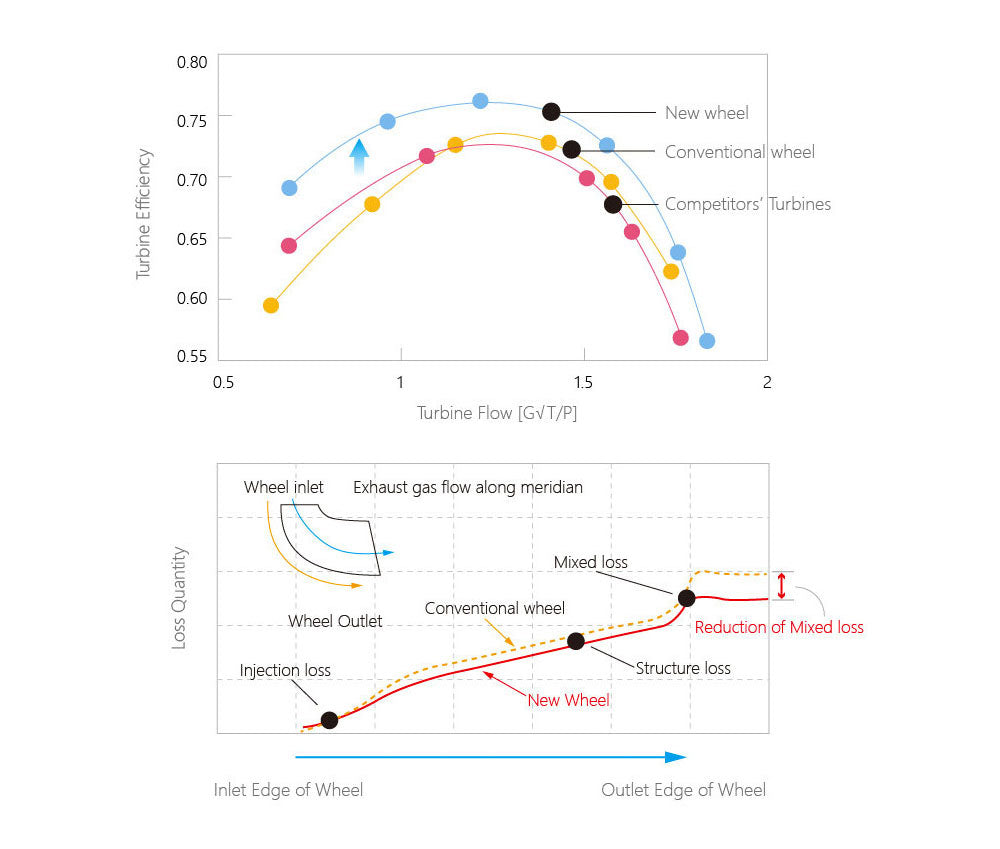
The STS 55 uses a patent-pending splitter-blade design to reduce exhaust manifold pressure (EMAP) by operating at a lower expansion ratio. Key benefits:
- More horsepower and torque — reduced backpressure allows the engine to breathe freely.
- Higher volumetric efficiency — lower EMAP improves air/fuel ingestion and throttle response.
- Reduced knock sensitivity — lower EMAP permits more aggressive tuning.
- Lower exhaust gas temperatures — reduced thermal stress on engine components.
The STS 55 achieves the high flow of a low blade-count turbine while maintaining the efficiency of a high blade-count design — eliminating the traditional trade-off.

STS Advanced: Ceramic Dual Ball Bearing Explained
The STS Advanced replaces the journal bearing with a ceramic dual ball bearing system. Inner and outer races with ceramic balls replace oil as the primary shaft orientation control — reducing friction, improving response by 10–15%, and extending service life under high-load conditions. Oil lubrication is still required.

4. Compressor Maps: TD02 to TD08
The compressor map below shows the flow range and pressure ratio for each TD series frame — use this to match the right turbo to your target power level.

5. Enhanced Internal Spare Parts
 |
 |
| CFD-Designed Turbine Wheel: Optimized exhaust gas flow increases throughput, reduces backpressure, lowers EGTs, and removes material mass — reducing rotational inertia and improving moment of inertia for faster spool. | 360° Performance Thrust Bearing Kit: Durable under heavy loads without sacrificing transient response. Standard across Kinugawa performance upgrade units. |
6. Crank Horsepower Range by Frame Size
Use the chart below to identify which TD series frame matches your target crank horsepower. Downloadable in A3 and A4 formats.

7. Actual Case Study: Mazdaspeed 3 / 6 MZR DISI 2.3L Turbo Upgrade
The Mazdaspeed 3 and Mazdaspeed 6 MZR DISI 2.3L platform is one of the most instructive real-world examples of how the TD series frame selection directly determines power ceiling, spool character, and reliability. The factory turbocharger — a BorgWarner K04 variant (K0422-881 / K0422-882) — is rated for approximately 260–280 WHP and fails predictably above 21 PSI due to its 270-degree thrust bearing and undersized turbine exducer. The following case study applies the TD series selection framework to this platform across three power tiers.
For the full engineering analysis of the OEM K04’s limitations and the complete system integration guide, see: Best Turbo Upgrade for Mazdaspeed 3 & 6 MZR DISI 2.3L — Full Engineering Guide →
7.1 Platform Baseline: OEM K04-882
| Parameter | OEM K04-882 |
|---|---|
| Compressor Inducer / Exducer | 45.0 mm / 56.25 mm |
| Turbine Inducer / Exducer | 50.1 mm / 44.5 mm |
| Blade Technology | Cast 12-blade |
| Bearing Type | Journal — 270° thrust pad |
| Turbine Housing | Small A/R (tight) |
| Max Reliable Output | ~260–280 WHP |
| Primary Failure Mode | Thrust bearing wear above 21 PSI; turbine seal oil leak |
7.2 Tier 1 — Street Build: TD05H-18G (350–400 WHP)
The TD05H-18G is the direct bolt-on replacement for the K04. It retains full compatibility with the stock exhaust manifold and downpipe flanges while delivering a 12% larger compressor inducer area and a 21% larger exducer diameter. The 360° thrust bearing eliminates the K04’s primary failure mode. The STS 9-blade turbine wheel reduces EMAP and builds boost 5–8% faster than the OEM 12-blade unit.
| Parameter | TD05H-18G |
|---|---|
| Compressor Inducer / Exducer | 50.3 mm / 68.0 mm |
| Turbine Inducer / Exducer | 56.0 mm / 49.2 mm |
| Turbine Housing | 7 cm² / AR.49 (Mitsubishi-derived) |
| Blade Technology | Billet 6+6 or 11+0 compressor; STS 9-blade turbine |
| Bearing Type | Journal (360°) or STS Advanced ball bearing |
| Target Output | 350–400 WHP |
| Inlet Size | OEM (bolt-on, no intake modification required) |
TD series code applied: TD05H frame + 18G compressor wheel + 7 cm² turbine housing = TD05H-18G-7cm

7.3 Tier 2 — Built Engine / Aggressive Street: TD05H-20G 3" Anti-Surge (450–500 WHP)
The TD05H-20G steps up the compressor inducer to 52.3mm, extending the efficiency map to support 25–30 PSI without superheating the intake charge. The 3" ported shroud (anti-surge) compressor cover prevents surge at low RPM by recirculating excess air — critical on a 2.3L engine where the larger compressor wheel can outpace engine demand at low speeds. The turbine housing remains 7 cm² / AR.49 for street-friendly spool.
| Parameter | TD05H-20G 3" Anti-Surge |
|---|---|
| Compressor Inducer / Exducer | 52.3 mm / 68.0 mm |
| Turbine Inducer / Exducer | 56.0 mm / 49.2 mm |
| Turbine Housing | 7 cm² / AR.49 |
| Compressor Cover | 3" ported shroud (anti-surge) |
| Blade Technology | Billet 6+6 or 11+0 compressor; STS 9-blade turbine |
| Bearing Type | Journal (360°) or ball bearing |
| Target Output | 450–500 WHP |
| Intake Modification Required | Yes — 3" intake system to match compressor inlet |
TD series code applied: TD05H frame + 20G compressor wheel + 3" anti-surge cover + 7 cm² turbine housing = TD05H-20G-3"-7cm

7.4 Tier 3 — Track / Competition: TF06-18K Ball Bearing 4" (550+ WHP)
The TF06-18K represents the top-tier application of the TD series framework on the Mazdaspeed platform. The TF06 frame uses a larger bearing housing than the TD05H, accommodating a 55.1mm / 75.0mm billet 7+7 point-milled compressor wheel and a 61.5mm / 54.0mm turbine wheel. The 4" anti-surge inlet eliminates surge entirely at high boost. The STS Advanced dual ceramic ball bearing reduces spool time by 10–15% versus the journal bearing variant and is mandatory for sustained high-boost track use.
| Parameter | TF06-18K Ball Bearing 4" |
|---|---|
| Compressor Inducer / Exducer | 55.1 mm / 75.0 mm |
| Turbine Inducer / Exducer | 61.5 mm / 54.0 mm |
| Turbine Housing | Mazda-specific flange |
| Compressor Cover | 4" ported shroud (anti-surge) |
| Blade Technology | Billet 7+7 point-milled (KX series); 9-blade turbine |
| Bearing Type | STS Advanced — dual ceramic ball bearing |
| Target Output | 550–600+ WHP |
| Intake Modification Required | Yes — 4" intake system |
TD series code applied: TF06 frame + 18K compressor wheel + 4" anti-surge cover + ball bearing CHRA = TF06-18K BB 4"

7.5 Full Specification Comparison: OEM K04 vs Kinugawa Upgrades
| Feature | OEM K04-882 | TD05H-18G | TD05H-20G 3" | TF06-18K BB 4" |
|---|---|---|---|---|
| Comp. Inducer | 45.0 mm | 50.3 mm | 52.3 mm | 55.1 mm |
| Comp. Exducer | 56.25 mm | 68.0 mm | 68.0 mm | 75.0 mm |
| Turbine Inducer | 50.1 mm | 56.0 mm | 56.0 mm | 61.5 mm |
| Turbine Exducer | 44.5 mm | 49.2 mm | 49.2 mm | 54.0 mm |
| Blade Tech | Cast 12-blade | Billet 6+6 / 11+0 | Billet 6+6 / 11+0 | Billet 7+7 (Point-Milled) |
| Turbine Tech | Standard | STS 9-blade | STS 9-blade | 9-blade |
| Bearing | Journal (270°) | Journal (360°) / Ball | Journal / Ball | STS Advanced Ball Bearing |
| Inlet Size | OEM | OEM (bolt-on) | 3" anti-surge | 4" anti-surge |
| Max HP Rating | ~260–280 WHP | 350–400 WHP | 450–500 WHP | ~550–600+ WHP |
7.6 Mandatory Supporting Modifications
Regardless of which tier is selected, the following supporting modifications are required on the MZR DISI 2.3L platform:
- HPFP Internals (Mandatory for all tiers): Autotech or CorkSport — the stock high-pressure fuel pump cannot maintain rail pressure above stock airflow levels. A lean condition under boost causes immediate detonation and engine failure.
- ECU Tune (Mandatory for all tiers): Cobb Accessport or Versatuner — required to rescale MAF calibrations, adjust load targets, and optimize ignition timing for the new turbo’s efficiency islands.
- Downpipe: 3-inch high-flow or catless — minimizes post-turbine backpressure and allows the STS turbine to extract maximum exhaust energy.
- Intercooler: FMIC or upgraded Top Mount (3.5" core) — the stock TMIC heat-soaks under increased mass flow, raising intake temps and triggering knock retard.
- Intake: 3" (Tier 2) or 4" (Tier 3) intake system to match the compressor inlet diameter.
- Oil Feed: Journal bearing units — -4AN feed line, no restrictor. Ball bearing units — 1.0–1.5mm restrictor orifice mandatory to prevent bearing flooding.
- Oil Drain: Must be vertical within ±15°. Any uphill section causes oil to back up into the CHRA and leak into the exhaust.
- Boost Control: 3-Port Electronic Boost Control Solenoid (EBCS) for precise boost management.
WHP figures are flywheel estimates based on compressor choke flow. Actual results depend on engine health, fueling, tuning, and supporting modifications.
2 comments
Sorry the STS turbine codes are hard to understand. The x2 codes are STS and STS55. Aside from the number of turbine blades between these codes, does this mean that STS is standard and STS55 is the STS advanced version with the ceramic ball bearings? Or are both STS and STS55 codes using Ceramic ball bearing technology and both classed as advanced? I guess its not clear to me which code is STS advanced? If you can help clarify please. Thanks
This is great info. Is there more data about the TD06SL2 16g 18g 20g and 7cm 8cm. Is there turbo maps for the TD06Sl2 lineup?